Returning customer? Login     
Online Real Estate Appraisals from Electronic Appraiser   Online Real Estate Appraisals from Electronic Appraiser
homewhysample reportsorder reportPartner with ElectronicAppraiser.combusiness accountsNews & Articlesfree services

Friday, January 11, 2008

Inexpensive Ways To Give Your Home A Facelift

If you are looking to sell your home or even have it appraised, you want to get the most value you can for your money.

Those of you who have taken up home improvement projects know that there is a monetary return for every improvement investment. Although the actual cost and payback for each project can vary, depending on both your home's condition and overall real estate market values in your region of the country, here a few things you can do that will most likely improve your home’s worth.

1. Make your kitchen really cook. The kitchen is still considered the heart of the home. Potential homebuyers make a beeline for this room when they first view a home for sale, so make sure your kitchen looks clean and reasonably updated.

For a few hundred dollars, you can replace the kitchen faucet set, add new cabinet door handles and update old lighting fixtures with brighter, more energy-efficient ones.

If you've got a slightly larger budget, you can give the cabinets themselves a makeover. You don’t need to replace your cabinets, hiring a company to reface them can give you the same results for less money. If you're handy, you can order your own replacement cabinet doors and door fronts from retailers like Lowe's Home Improvement or The Home Depot and install them yourself.

2. Give appliances a facelift. If your kitchen appliances don't match, order new doors or face panels for them. Many dishwasher panels are white on one side and black on the other, so if you are trying to match everything up, slide out the panel and flip it around.

A more cohesive-looking kitchen makes a big difference in the buyer's mind -- and in the home's resale price.

3. Buff up the bath. Next to the kitchen, bathrooms are often the most important rooms to update. They, too, can be improved without a lot of cash. Simple things like adding a new toilet seat and a pedestal sink are pretty easy for homeowners to install, and they make a big difference in the look of the bath.

If your bathroom floor is old and discolored, try replacing tiles with easy-to-apply vinyl tiles or a small piece of sheet vinyl. You may not even need to take up the old floor. You can install the new floor right over the old one.

If your tub and shower are looking dingy, consider re-grouting the tile and replacing any chipped tiles. A more complete cover-up is a prefabricated tub and shower surround. These one-piece units may require professional installation but can still be cheaper than paying to re-tile walls and refinish a worn tub.

4. Step up your storage. Old houses, particularly, are notorious for their lack of closet space. If you have cramped storage areas, try adding do-it-yourself wire and laminate closet systems to bedrooms, pantries and entry closets.

5. Add a room in a week or less. "If you have a three-bedroom house with a den, the only reason the den can't be considered a bedroom may be because it doesn't have a closet. If you add a closet to that room, you've now got a four-bedroom house. That adds a lot of value."

6. Mind the mechanics. Spending a few bucks on nitty-gritty stuff such as repairing leaks, wrapping or fixing loose wires, and fixing any faulty outlets.

7. Look underfoot. Carpeting is another detail that can quickly update a home and make it look cleaner. A professional carpet cleaning is an inexpensive investment, especially if your rugs are in good shape and are neutral colors.

If your carpet is showing serious wear, cover it with inexpensive, strategically placed area rugs. Unless it is truly hideous, most Realtors don't suggest replacing wall-to-wall carpeting right before you sell your house. The new homeowners may want to choose their own carpeting after they move in.

8. Let there be light. If you have boring recessed lights in your dining and living rooms, consider replacing one of the room's lights with an eye-catching chandelier. Home stores offer a wide range of inexpensive, but nice-looking, ceiling fixtures these days. If you have a ceiling fan and light, you can also buy replacement fan blades (leaving the fan body in place) to update the fixture's look.

9. Reframe your entry. Do you have a flimsy little knob on your main entry door? If so, spring for a substantial-looking handle-and-lock set. A nice, big piece of hardware on the front door signals to newcomers that this is a solid home.


Greg Sullivan is the President of www.electronicappraiser.com, a leading provider of home appraisals offering a nationwide personalized instant home appraisal service. For more information, please visit www.electronicappraiser.com.

Please visit Electronic Appraiser - www.electronicappraiser.com - for more information.

Wednesday, January 9, 2008

Improving Your Home's Resale Value

Are you getting ready to sell your home and want to get the most for the value? If so, there are a few simple things you can do that won’t necessarily cost you a fortune.

First of all, when potential buyers drive up to your house, the first thing they see is the front of your house. Knowing that the exterior of the house usually is a good indicator of the inside of the house, you want your home to have curb appeal and make buyers want to see the rest of the house. So here are some quick things you can do.

1. Mow the lawn regularly while your home is on the market. If you have patches in your yard where grass doesn’t grow, you can either sow some grass seeds or sod the areas. If the bare area is at the base of a tree, you could turn the spot into a flowerbed.

2. While we’re on the subject of flowerbeds, be sure to keep these areas weeded when trying to sell your home. Adding pine straw or mulch can freshen up your yard and make your yard look well cared for.

3. Add some color to your yard by planting flowers. You can use them in beds, hanging baskets, or flowerpots. Planting flowers can help to liven up a house, especially if the home is older or more traditional. And, be sure to pick vibrant colors over pastels or white in order to give the full effect.

4. Clean your windows. People always look out of the windows when they’re viewing a home. So, cleaning the windows will help the view from the interior and the exterior!

5. Use a pressure washer to clean sidewalks and driveways. Pressure washing cement, especially, can make it look as though it was freshly poured.

6. Make your front door inviting. Since most potential buyers enter your home through the front door, you want to pay attention to this part of your home. If there are any shoe marks at the base (or hand marks near the handle), be sure to clean those. Depending on the type of door you have, you can also give it a fresh coat of paint.

7. Examine your home’s exterior. If your home has siding, check to see how clean it is. If you see collected dirt or pollen, you can clean these surfaces fairly easily with a pressure washer. If your home is painted, check to make sure the paint is not chipping away. If your home was painted recently, you may just want to hose off (or gently pressure wash) any visible dirt. If your home is in need of new paint, be sure to choose neutral colors.

8. While your pet may be your pride and joy, even a friendly dog’s barking may frighten a buyer. If you can’t remove your dog, try to confine it to the garage or dog run. Many buyers are allergic to cats, so be sure litter boxes are clean.

9. Remove the clutter from inside your home. If your home has too much furniture, overflowing closets, junk sitting in corners, and crowded kitchen and bath countertops, potential buyers cannot see your home. Removing clutter will make your home appear bigger and brighter

10. Clean your house. Buyers want to move into a clean home. They feel more assured of that prospect if the home is spotless at it’s showing. Clean walls, baseboard trim, window sills, light switches, doors, and light fixtures. Steam clean carpets and dust window blinds. Dust/wash off lint from the washer and dryer, even wash off the furnace and hot water heater. A sparkling clean home is sure to impress!

11. Do everything you can to brighten the interior of your home. Pull back your curtains and drapes so prospects can see how bright and cheery your home is. Let the sun shine in! For an evening showing, turn on all the lights - both inside and outside. Light adds color and warmth, and makes prospects feel welcome. During the winter, maintain a comfortable temperature even if you are away for an extended time.


Greg Sullivan is the President of www.electronicappraiser.com, a leading provider of home appraisals offering a nationwide personalized instant home appraisal service. For more information, please visit www.electronicappraiser.com.

Please visit Electronic Appraiser - www.electronicappraiser.com - for more information.

Sunday, January 6, 2008

Are You Ready To Buy Your First Home?

There are many great reasons to own a home. For one, the place is yours.

When you own your own home you have a place to raise your children and to be a part of a community. You can even pass your home down to your children and their children, creating security for generations to come.

Owning your own home can even help you reduce your taxes. You can deduct the interest on your mortgage and property taxes you pay on your home on the tax returns you file each year. These tax savings partially reduce, or offset somewhat, the actual cost of owning your home.

Another good reason to own your own home is that your monthly payments won’t ever go up, that is if you choose a fixed-rate mortgage! A fixed mortgage is one that stays the same for the life of the loan. If the mortgage is 30 years, you’ll pay the same mortgage payment each month for the entire 30 years of the loan.

So what are the risks of owning a home, you might ask? Overall, homeownership is a good investment for most people. If you understand the benefits and risks of homeownership, you can make the best decision about when to buy a home.

The first risk is that your monthly housing expenses can increase if your mortgage is higher than what you are used to paying in rent. On the flip side, rent goes up while your mortgage can stay the same. Another risk is that if an appliance breaks, you will have to pay for its repair or replacement. You are also responsible for the maintenance and upkeep of your home and your property.

If you are somebody who plans to move soon, the downfall of owning is that you have to wait to sell your home to move. Depending on the local real estate market, you might not be able to sell your home quickly. You should also factor in the likely expense of hiring a real estate professional. Fees can be negotiated and vary across regions. They also vary from professional to professional.

The last risk is that property values can depreciate. You can lose value in your home for a number of reasons, such as a recession, the condition of your home not being kept up, or a drop in a neighborhood’s home values. If your home loses value and you have to sell it for less than you owe, you will be required to repay the full mortgage.

Many people don’t even consider buying a home as they believe that you need great credit to become a homeowner. The fact is, you may still be able to buy a home with less-than-perfect credit. And remember, you can improve your credit over time.

Another myth about buying a home that often keeps people from looking is that you need to put 20% down. There are many types of mortgage products and programs that allow low and no down payments. But remember to factor in other costs such as closing costs, property taxes, moving expenses, and repairs.

So are you ready to buy your first home? Certainly the benefits outweigh the risks.

Please visit Electronic Appraiser - www.electronicappraiser.com - for more information.

Tuesday, January 1, 2008

What Makes a Home "Green"?

Green is the new black, so to speak. Everybody is talking about going green and even building green. So what does it really mean to build green?

Defining green has been a challenge, even for those who are as green as you can get. To sum up green, the question would be – what type of environmental impact does the materials you are using have?

Assessing impact can mean on the front end or the back end. For example, in some instances, the product you use in building your home might not be green to build, but the results of that product can be beneficial. A good example would be if a window is installed in a way that maximizes the collection of low winter sunlight and blocks the summer sun, this saves energy and is green.

Because defining green is difficult, standards are starting to be organized and listed in the GreenSpec directory. This directory bases decisions about products on categories such as energy-consuming appliances and VOC-emitting paints, specific thresholds can be established relatively easily. But for many criteria, the lines are much fuzzier and judgment calls are required.

It is important also to note that multiple criteria often apply—in other words, a product may be considered green for more than one reason. Take recycled plastic lumber, for example: it’s made from recycled waste, it’s highly durable, and it can obviate the need for pesticide treatments. Straw particleboard products are made from agricultural waste materials, and they are free from formaldehyde off-gassing. A product with multiple benefits could qualify for GreenSpec on the basis of its overall environmental performance, even if it doesn’t meet a threshold in any one category alone. Conversely, a product with one or more green attributes might not qualify if it also carries significant environmental burdens. For example, wood treated with toxic preservatives has advantages in terms of durability, but it would not be listed in GreenSpec due the health and environmental hazards it represents.

The primary intent with any green building products directory is to simplify the product selection process.

Another way to build green is to conform to what is called LEED Standards. LEED or ‘The Leadership in Energy and Environmental Design’ is a Green Building Rating System™ that encourages and accelerates global adoption of sustainable green building and development practices through the creation and implementation of universally understood and accepted tools and performance criteria.

There are many resources available for consumers so that they can adapt their building materials and design to LEED standards. Building this way is probably the simplest way to go and there are many resources available to assist you.

So should you build green because it is popular? Not necessarily. You should build green because it is what will ultimately provide a ‘green’ future and not a black one.

Greg Sullivan is the President of www.electronicappraiser.com, a leading provider of home appraisals offering a nationwide personalized instant home appraisal service. For more information, please visit www.electronicappraiser.com.

Please visit Electronic Appraiser - www.electronicappraiser.com - for more information.
Saturday, December 29, 2007

Improving the value of your home with bamboo flooring

If you are looking to increase the value of your home, replacing old carpets or tile with a beautifully laid bamboo floor will certainly help. And if your home isn’t up for resell and you just want to have beautiful flooring, using bamboo is an elegant and affordable way to go.

Bamboo flooring may only be a little over ten years old, but its beauty and environmental factors have spoken for itself. And, floor experts have discovered that bamboo is actually harder than hardwoods such as Maple and Oak. Not only that, bamboo is extremely eco-friendly, and stands up the look, feel, sound, and warmth of its hardwood peers.


When we think of bamboo, we see reeds of tall grasses growing in tropical locations. So how does a grass become transformed into a wood floor? For starters, only a particular type of Bamboo is used, most often the Moso variety. Once Moso poles reach 40 to 50 feet in height, they are harvested and dried. The drying process is slow, typically four years in the sun. The bamboo is then sliced into thin uniform strips and planed on all sides. The pieces are converted into flooring made of either two or three layered horizontal or vertical laminated pieces. Bamboo can either be nailed to a wood subfloor or glued directly to a concrete sub-floor. Floating is not recommended. There is a variety of moldings made available as well to hide expansion gaps and for staircases.

Bamboo flooring comes in a variety of colors. Pretreated, coloring choices are natural and smoky amber. If the product comes to the states untreated, stains can vary from pinks to a variety of browns. Because bamboo is a grass rather than a tree, its finished appearance is very distinctive. Most distinctive is the eye-catching pattern of slightly darker bands produced by its nodes – a feature that clearly sets it apart from wood. Bamboo’s other aesthetic features include the tightness of its grain and the uniformity of its color.

These untreated and stained pieces of bamboo flooring are then given a final coating, typically made up of an aluminum oxide and polyurethane scratch-resistant topcoat. Coatings can be matte or glossy, with glossy tending to scratch more easily than matte.

Bamboo’s popularity has continued to grow with its discovery. The fact that it is a grass, a quickly renewable resource that yields a product 25 times faster than timber, has been of primary interest to the environmentally conscious. The beauty is an added bonus. With the cost of bamboo equivalent to oak flooring, it isn’t hard on the pocketbook either. Bamboo is also easy to clean and considered ideal for allergy sufferers, as they do not harbor dust mites.

When cleaning bamboo, a soft touch is best to prevent minute scratches on the surface. A padded cleaning head on your vacuum cleaner or a damp mop is most appropriate. This method will keep dust and debris from accumulating and scratching your bamboo floor. You should also take care never to over wet your bamboo floor. While it is resistant to moisture due to its tropical origins, it is best to minimize moisture exposure to help preserve the material. Mop spills using a damp cloth and dry immediately.

Putting area rugs on pathways that may experience high traffic. This keeps the bamboo floor from scuffing due to the high amount of traffic in a certain area. To prevent dirt and other debris from coming onto the floor from the outside, place exterior mats in entryways. Gravel and debris stuck in the bottom of shoes may scratch the finish of your bamboo floor.

If you have pets, remember to regularly trim your pets' nails to prevent them from scratching and gouging the bamboo floor. And of course, when moving furniture from one place to another, lift them instead of dragging them along the floor.

So if you are ready to transform the look of your home, putting in bamboo flooring will give you a huge start.

Greg Sullivan is the President of www.electronicappraiser.com, a leading provider of home appraisals offering a nationwide personalized instant home appraisal service. For more information, please visit www.electronicappraiser.com.

Please visit Electronic Appraiser - www.electronicappraiser.com - for more information.

Tuesday, December 18, 2007

Fee VS. Free AVM Reports

What's the difference between free home value reports and AVM reports provided by ElectronicAppraiser.com?

Don´t be misled by companies promising automated values for free - they often come with a hidden price. Your information can be collected and given to people interested in selling you something! ElectronicAppraiser.com offers you a "hassle free" report. Your information is private and secure!

Please visit Electronic Appraiser - www.electronicappraiser.com - for more information.

Friday, December 14, 2007

Seven tips for sellers from "The Today Show"

As seen on "The Today Show" Friday 12/14/2007. http://www.thetodayshow.com

Our first report recommends seven tactics for selling a home more quickly, at a higher price. What matters most of course is the home itself, not how it is sold. But we still believe that these tactics can yield a small but significant improvement in a home-seller's results. We also hope that sharing with consumers, academics and industry peers will open a dialogue about which tactics work and which don't.

You can read the full report Seven Tactics for Selling a Home, or visit our forum to ask the authors a question.

1. Don't overprice your property: Once a property fails to sell at its debut price, the time it spends on the market can encourage buyers to become more aggressive in negotiating. Price reductions can further encourage aggressive bargaining. In a 2002 study of 3,490 Stockton, California listings, homes without a price reduction sold for 97% of initial list price, whereas homes with a price reduction sold for 88% of initial list price, a difference likely greater than the actual magnitude of the price reduction.

2. Set your price to show up in web searches: Seventy-two percent of California home buyers use the Internet as "an important part of the home-buying process." The real estate sites used by home buyers typically filter price in $25,000 or $50,000 increments, so a home selling for $350,000 is likely to be seen significantly more than a home selling for $355,00 because the $355,00 home will be excluded by buyers who set $350,000 as their maximum price. According to a September 2007 Redfin analysis of its own traffic in the San Francisco Bay Area and Seattle markets, moving from one price band down to the next can increase online activity by as much as 7.1%. Download the graphs for the Seattle area and for the San Francisco Bay region.

3. Debut on Friday: According to a December 2007 analysis of Redfin's website traffic for 119,079 listings, homes that debut on the best day, Friday, get on average 7.7% more visitors in their first seven days than those that debut on the worst day, Thursday.

4. Stay engaged: Several studies emphasize the importance of being an informed, active home-seller. The study most to the point, a 1998 survey of 115 sellers in Columbus, Ohio, found that motivated sellers are able to sell their property as much as 30% faster than typical sellers. Motivated sellers may be more willing to bargain, but the authors also speculate that such sellers motivate agents to be more aggressive on their behalf.

5. Market the property online: A December 2007 Redfin study of 121 of its own listings from September 1, 2007 to November 30, 2007 found that a craigslist posting about a listing generated an average of 6.8 visits to that listing on Redfin's website. That each visitor navigates from craigslist to Redfin to see the listing in detail suggests that many may be serious potential buyers.

6. When selling your home, stay put: The pricing study of 3,490 Stockton listings found that vacant homes were 9.5% more likely to undergo a price reduction, which the author speculated was the result of a perception among buyers that the owners were anxious to sell.

7. If you can, wait to list your property until neighboring foreclosures are off the market: A November 13, 2007 report from the Center for Responsible Lending estimates that a foreclosure costs neighboring homeowners an average of $5,000 when listing their property. The banks selling foreclosed properties are often eager to sell at any price. If you can't wait to list your property until any neighboring foreclosures are off the market, you will have to account for the effect of the foreclosures in your own pricing.

Please visit Electronic Appraiser - www.electronicappraiser.com - for more information.

Monday, October 15, 2007

Guide to State Real Estate Laws and Regulations

Real Estate Laws in Your State

Click a state to learn about laws or regulations affecting competition in real estate.


Please visit Electronic Appraiser - www.electronicappraiser.com - for more information.

Thursday, October 11, 2007

Estimated Median Home Sales Prices (1998-2007)

Median Home Sales Prices, 1998-2007

  • Median home prices are from “U.S. Housing Market Conditions,” U.S. Department of Housing and Urban Development. Home prices are a weighted average of new and existing home prices, based on annual sales.
  • Median home prices are converted into 2006 dollars with the consumer price index for all goods for urban consumers (CPI-U) from the U.S. Bureau of Labor Statistics.
  • 2007 home prices are based on the first half of 2007.
Source: United States Department of Justice www.usdoj.gov

Wednesday, October 10, 2007

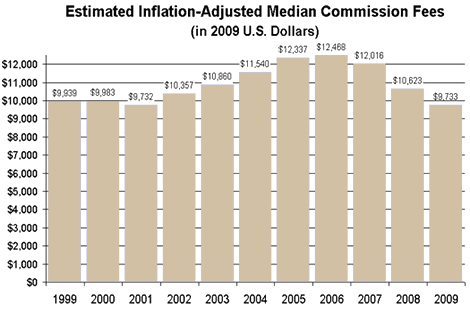
Estimated Median Commissions Paid by Consumers (in 2006 dollars)

This graph shows the median commission paid by consumers for these years:

Median Commissions Paid by Consumers, 1998-2007

  • Inflation-adjusted median commission fees are calculated by multiplying commission rates (from REAL Trends 500©) by inflation-adjusted median home prices.
  • The 2007 commission rate is assumed to be equal to the 2006 commission rate.
Source: United States Department of Justice www.usdoj.gov

Sunday, October 7, 2007

DOJ launches Web site on real estate competition

DOJ launches Web site on real estate competition
The U.S. Justice Department's Antitrust Division today launched a new Web site focused on competition in the real estate industry that includes charts on real estate commission costs and potential savings from low-cost real estate brokerage companies. The new website is located at www.usdoj.gov

How to Contact the Antitrust Division
If you have questions or comments about competition in the real estate industry or if you have information concerning anticompetitive conduct, e-mail the Antitrust Division.

Thursday, August 23, 2007

The majority of people who use the Web for real esate are using it to search home listings, according to Realestate.com.


The majority of people who use the Web for real estate are using it to search home listings, according to Realestate.com. This redesigned site focuses on home listings and home-valuation tools. The site, which recently launched a home-listings engine featuring 46 major metropolitan markets, offers unlimited use of most services and does not require e-mail registration.

Please visit Electronic Appraiser - www.electronicappraiser.com - for more information.

Tuesday, August 14, 2007

Things to consider before hiring movers

Whether you're moving down the street or across the country, spending a few minutes preparing for your move will save you time and money. Here are a few things to consider before hiring the movers:

  • Throw away as much as you can before you start packing. If you take junk, you'll be throwing it away or finding places to store it on the other side.
  • Start collecting packing materials as soon as you know you're moving. Save your newspapers, and order boxes and packing tape online from discount stores.
  • Sign up for your new utility accounts. Don't expect the seller (or landlord) to set up your new electrical, cable, gas, water or telephone accounts for you. Start this process at least three weeks before the move.
  • Reserve the elevators. If you live in or are moving to a condominium or co-op, you'll probably have to reserve elevators on the day you hope to move. Since most buildings only allow one or two moves a day (they'll only allot one elevator to the move), you'll need to call weeks ahead of time or risk losing your preferred moving day.
  • Discontinue delivery services at your existing home. If you get anything delivered (newspapers, milk, dry cleaning, laundry or videos), be sure to change the delivery address on the account. And, don't order anything that is scheduled to be delivered to your old address within a week of your move. You don't want it to turn up after you're already gone.
  • Change-of-address cards or e-mail. If you're mailing change-of-address cards, try to do this at least two weeks before you move. If you're e-mailing everyone, send these out a week or two ahead of time, and then again announcing that you're now living in your new home (with the address and telephone numbers. Don't forget to stop by your local post office to fill out your change-of-address card at least two weeks before your move. (You may have to do it again later.)
Please visit Electronic Appraiser - www.electronicappraiser.com - for more information.

Monday, August 6, 2007

Moving Tip - The Day After Your Move

  • Locate your local post office, police, fire stations and hospitals as well as gas stations near your home.
  • Get familiar with your neighborhood shopping areas. You may need house wares, tools or other items for your new home unexpectedly.
  • Call the department of sanitation in your new home to find out which day the trash is collected and what type of recycling programs are available in your community.
  • Get new service providers such as a bank, pharmacist, cleaner, cable television etc.
  • Contact your local DMV if you moved to a different state to exchange your driver’s license.
  • Provide your new doctor and dentist with your medical history.
  • Transfer insurance policies to your new agent. You may also wish to make a detailed list of your belongings, their value, and you coverage.
  • Get information on schools, libraries, community activities and emergency calling service from your local Chamber of Commerce.
For moving tips and service, you can visit the NEW "Moving Services Center" at Electronic Appraiser - http://www.electronicappraiser.com/moving.cfm

Please visit Electronic Appraiser - www.electronicappraiser.com - for more information.

Thursday, July 26, 2007

The Mortgage Team and What They Do

Article Source - Anthony Sands pres@gstarhome.com

Since obtaining a mortgage is often the largest financial decision in your life it is important for you to know who is involved in your loan application process.

Loan Officer (Mortgage Broker) - This is the person who will meet with you to discuss your program options and recommend to you the best program to meet your needs.

The loan officer will then take your loan application and follow it through to the actual settlement or closing.

Processor - This is the person who will be working on your file to prepare it for submission to the underwriter for approval. The processor will usually order the appraisal and all of the other forms needed to verify your income and assets.

Underwriter - The underwriter is the person who will either approve your loan application or decline it if it does not meet the program guidelines.

The key to a smooth and successful transaction is working with a loan officer who knows the guidelines and knows how to package your loan application so the underwriter has no choice but to approve your application.

Loan Closer - The loan closer is the person who makes sure all of the paperwork necessary for the settlement or closing on your new home are in order. The closer will communicate with the title attorney to coordinate your settlement and make sure all of the documents you need to sign are correct and more importantly that the funds you are borrowing are at the settlement table on time.

Please visit Electronic Appraiser - www.electronicappraiser.com - for more information.

Wednesday, July 18, 2007

Moving and Storage Services (NEW)

New Service!!!

ElectronicAppraiser.com now offers FREE and FAST Moving Quotes. If you are planning a move, Need Storage for your things, maybe transport your car from one state to another state. Then don't hesitate to visit our new Moving Center at - http://www.electronicappraiser.com/moving.html (It's a Fast and Free Service)

Please visit Electronic Appraiser - www.electronicappraiser.com - for more information.

Monday, July 9, 2007

In the News (ElectronicAppraiser.com)

From OrlandoSentinel.com - July 8, 2007
http://www.orlandosentinel.com/features/consumer/orl-homebase0807jul08,0,7254094.story

On the Web

The majority of people who use the Web for real estate are using it to search home listings, according to Realestate.com. This redesigned site focuses on home listings and home-valuation tools. The site, which recently launched a home-listings engine featuring 46 major metropolitan markets, offers unlimited use of most services and does not require e-mail registration.

Here are a few of its features:

More than 2 million listings.

Cooperation with local multiple-listing services in each covered market.

Interactive mapping tools with aerial photos powered by Ask.com.

Home-valuation tools through a partnership with Electronic Appraiser.

Comparables of recently sold properties.

Neighborhood and school information.

A library of editorial and educational content for buyers and sellers.

Compiled and written by Martha Phifer. She can be reached at 407-420-5259 or mphifer@orlandosentinel.com.

Please visit Electronic Appraiser - www.electronicappraiser.com - for more information.

Wednesday, June 6, 2007

Enhancing Your Home's Curb Appeal

Once you have identified and addressed your trouble areas, you can then focus on items that enhance your homes curb appeal. Even with a limited budget your can greatly enhance your homes visual appeal by focusing on a few key areas. Items you may consider include:

  • Adding colorful seasonal plants to existing flower beds.
  • Purchasing new house address numbers and mailbox.
  • Installing a new door with glass inserts.
  • Placing a new welcome mat and a grouping of potted plants at the entrance.
  • Installing lighting along your driveway or sidewalk.
Photographing Your Home's Curb Appeal Make sure the photographer takes the best pictures. Great pictures of your home increases your changes of a successful sale. According to the National Association of Realtors, 70 percent of home buyers view a home for the first time from a picture on the Internet. Most Internet shoppers will skip listings with no pictures, and many will skip listings that only have a few pictures. If a picture is worth a thousand words, then what is 20 or more pictures worth?

Here are few tips from professional real estate photographers:

  • Make sure your lawn is mowed and edged.
  • Remove cars, pets, and toys before shooting.
  • Request shots from multiple angles and levels.
  • Find angles that show most of your property without looking cluttered or untidy by the surrounding landscape. Relay this information to the photographer.
  • Include as much as of the front lawn and landscape as possible. If your lawn or landscape is not at its best, request the photographer shoot from an angle that includes more sky.
Please visit Electronic Appraiser - www.electronicappraiser.com - for more information.

Friday, June 1, 2007

Real Estate Market Watch for June 2007

Stricter lending standards and a decline in a subprime mortgage originations have contributed to somewhat lowered expectations for existing home sales in NAR's latest housing market outlook, compared with its earlier forecasts.

  • Existing-home sales are likely to total 6.29 million this year and 6.49 million in 2008, compared with 6.48 million last year.
  • New-home sales, projected at 864,000 in 2007 and 936,000 next year, will be lower than the 1.05 million recorded in 2006.
  • Housing starts should total 1.46 million units this year and 1.52 million in 2008, down from 1.80 million last year.
  • The national median existing-home price is forecast to slip 1% to $219,800 this year, and then rise 1.4% in 2008. The median new-home price is expected to be essentially unchanged at $246,400 in 2007, and then rise 2.2% next year. "If it weren't for a favorable economic backdrop, housing would probably have a hard landing," says NAR Senior Economist Lawrence Yun. "As it is, we see this as a soft landing with home sales rising gradually in the second half of the year and prices recovering a bit later."
Please visit Electronic Appraiser - www.electronicappraiser.com - for more information.

Tuesday, May 29, 2007

The Power of Permits

It doesn't make good financial sense to spend a lot of money on a major renovation without obtaining the building permits that are required by law. The value of the work can be diminished if required permits aren't obtained. In some places, you might be required to undo work that was done without permits. And, you could be stopped from completing a job until you obtain the necessary permits.

To make sure that you don't get into trouble when you sell you home, check with your local city or county building department to find out what, if any, permits are required before you start a home renovation project. Not all projects require permits, and this will vary somewhat from one place to the next.

Generally, permits are required for work that might impact the health and safety of a building occupant, like running a new gas line so that you can relocate your furnace. Structural modifications or additions also usually require permits. You may need several permits for such things as foundation, electrical and mechanical.

Permits can be obtained by homeowners or their contractor. You may be able to save money if you take out the permits yourself and agree to be present for inspections. Some contractors have been known to talk homeowners out of the permit process because it saves the contractor time.

Make sure if you do ask your contractor to take out permits that he actually does it. Some unsuspecting homeowners have discovered after a job was complete that the permits were never obtained. Keep copies of permits and make copies available to buyers when you sell your home.

Sometimes permits for work are obtained, but the final approval is never received. This can have implications for the next person who tries to take out a permit to do work on the house. A San Francisco Bay Area home buyer discovered after closing that a permit to change the furnace had never received the final approval.

Please visit Electronic Appraiser - www.electronicappraiser.com - for more information.

Wednesday, May 16, 2007

Foreclosure activity up 62% from last year

Foreclosure activity in April was up 62 percent from the same month a year ago, despite its 1 percent drop from the previous month, a foreclosure tracking service reported.

A total of 147,708 foreclosure filings -- including default notices, auction sale notices and bank repossessions -- were reported during the month, according to RealtyTrac. The company also reported a national foreclosure rate of one foreclosure filing for every 783 U.S. households in April.

Nevada, Colorado and Connecticut had the top foreclosure rates in the nation, according to RealtyTrac's data.

Please visit Electronic Appraiser - www.electronicappraiser.com - for more information.

Monday, May 14, 2007

Comparable Home Sales?

Comparable home sales, or “comps,” are what the professionals use to analyze the value of your property. Comps are one of the foundations of determining a home’s value.

Properties that are similar to the place you’re considering can tell you a lot about your own property’s value. Using information from the sales history of comparable homes, and the relative importance of different features, you can use comps to help determine the market value of your place.

Important factors to determining which properties are comparable to yours can include:

  • Proximity
  • Sale dates and prices
  • Number of bedrooms and baths
  • Square footage of the property and the land
  • Year built
  • Location, view, privacy, and noise
Please visit Electronic Appraiser - www.electronicappraiser.com - for more information.

Tuesday, May 1, 2007

Don't want to pay a real estate agent?

Blog posting adapted from Sun-Sentinel / MartketWatch written by Amy Hoak of MarketWatch. Click here for original news article.

Be prepared to do some work yourself.

With all the online real estate information available to home sellers nowadays, it's not surprising that some of them consider selling without the help of a real estate agent.

The biggest advantage of the for-sale-by-owner strategy is not having to pay commission to a listing agent. But those taking on the job themselves need to roll up their sleeves and prepare for a little work to get the home sold, understanding that they will be the ones taking care of tasks ranging from marketing to showing the property to interested buyers.

Prepare the house.

Before doing anything, make sure that the house is in good shape to show, said Piper Nichole, author of The For Sale By Owner Handbook. That means making sure it is clean, decluttered, odor-free, brightly lit and freshly painted. Curb appeal is also important.
She also advises thinking about offering buyer incentives such as flexible move-in arrangementsand providing a home warranty.

Price it correctly.

"The biggest mistake for-sale-by-owners make is pricing their home too high," Nichole said in an e-mail interview. If the home subsequently ends up sitting too long on the market and the asking price is lower, a potential buyer might speculate that something is wrong with the property, she said.

You can use ByOwnerMLS.com or ElectronicAppraiser.com to get a starting idea of what a house is worth. A look at a listings site, such as Realtor.com, will reveal what sellers are asking for in the neighborhood, he added.

If the home is unique and difficult to compare to others, consider having it appraised, Nichole said.

Decide how to use the savings.

Sellers also need to ask themselves if they want to use all or part of the commission they would otherwise pay in order to discount the property. A good route for most people is an in-between-approach use part of savings to attract a buyer faster and part of the savings as added profit.

Market it correctly.

The Internet can be a big help in marketing a property. ByOwnerMLS.com has partners with over 20 top "For Sale By Owner" websites which allows a seller to post a listing to gain Internet exposure on their site and ByOwnerMLS.com with no additional costs. Other online options include community marketplaces such as Craigslist.org and portals such as Yahoo. When placing a newspaper ad, make sure to ask if it will be posted online for free.

Don't underestimate the power of a sign. And consider listing on the Multiple Listing Service as well.

Additional Books and Resources To Help You Sell Your Home


For more information and to view recent property listings, please visit www.byownermls.com or Electronic Appraiser for instant home valution reports at www.electronicappraiser.com - for more information.

Monday, April 9, 2007

The 9 Deadly Mistakes Most For Sale By Owners Make

Web source - www.HelpMeSell.com

  1. Failing to offer buyers 24 hour access to their home via Internet tour and pre-recorded talking home hotline.
  2. Not working with a local Loan Officer - real estate agents do.
  3. Failing to analyze why they are selling. offer buyers 24 hour access to their home via Internet tour and pre-recorded talking home hotline.
  4. Not preparing their home for the buyer's eye.
  5. Pricing their homes incorrectly.
  6. Selling too hard during showings.
  7. Signing a long-term listing agreement without a written performance guarantee.
  8. Making it difficult for buyers to get information on their home.
  9. Failing to obtain a pre-approved mortgage for one's next home.

Please visit Electronic Appraiser - www.electronicappraiser.com - for more information.

Thursday, April 5, 2007

Solution To Avoid Foreclosure

"When a home goes into a foreclosure, owners still have a window of opportunity in which they can sell the home. By selling, rather than a foreclosure, the effects aren't so detrimental. That's one of the reasons the site www.investorsclassifieds.com began - to help frantic owners promote their property and sell quickly."

More families than ever are facing foreclosure on their homes, a red mark that can't easily be removed from their credit history. The good news is there is a way to avoid the financial ramifications caused by a home foreclosure.

When a home goes into a foreclosure, owners still have a window of opportunity in which they can sell the home. By selling, rather than a foreclosure, the effects aren't so detrimental. Ken Spohn of www.investorsclassifieds.com, offers the reason why so many more homes today are heading toward foreclosure than in recent years.

"Simply put, too many homebuyers trusted their loan officers," states Spohn. He explains how the sudden rise in interest rates for people who have ARMs (adjustable rate mortgages) have caught them off guard. Many times the substantial increase in their house payments has left making the payments impossible.

"Sadly, many buyers didn't known what they what they were getting into," he adds. "They thought they were buying the American dream with a low introductory rate, but in truth, they made a deal with the devil. Now that their mortgages are starting the adjustable period, rates are higher and at prices they can no longer afford."

According to Spohn, if you plan to sell your home to avoid foreclosure, you need to consider where to sell the home and how you go about it because it makes a difference.

"If you're going into foreclosure, don't list your property with a Realtor," he stresses. "Many people make this mistake. A Realtor simply doesn't have the time to sell your home prior to foreclosure proceedings. Also, understand that you won't get the full value for your property. If you can come to terms with that, then you'll be much further ahead of the rest of the people in foreclosure."

When asked about why a Realtor lacks the time Spohn explains, "A home listed with a Realtor is usually on the market for 60 days, if not more, before finding a potential qualified buyer. From that point, it can take three to four weeks for that buyer to get the financing and close on the property. To make matters worse, after all that, sometimes the buyer might not qualify for the loan or they change their mind about buying. In the end, precious time is wasted."

So if people shouldn't be selling through a Realtor, what's the best option to consider?

"The way to sell is through a qualified investor," states Spohn. "You need someone who knows how to deal with banks and who can save you from foreclosure. You won't make as much as you would through a conventional market purchase, but it can save you from the red mark of foreclosure."

His site, www.investorsclassifieds.com, was created with people facing foreclosure in mind or for those who want to sell their homes quickly.

"We offer sellers a wide range of options for sellers looking to sell their property - Free listing to $199.95 for a full-year membership," Spohn says. "With full membership, their listing is also placed on Google, ByOwnerMLS.com and oodle.com. With us sellers can connect with quality investment buyers."

For people in the Phoenix area, sometimes Spohn will do the buying directly.

"We can buy many homes in the Phoenix area, usually within 24 hours, or we work with the bank to help owners," Spohn says. "

Another option is to take over payments and give owners some cash if they have equity in their home." So for those people heading toward foreclosure, there is hope out there and a place to turn so the situation is less painful and more bearable.

Please visit Electronic Appraiser - www.electronicappraiser.com - for more information.

Friday, March 9, 2007

FSBO Tips

For homeowners who choose the FSBO route, Sambrotto offers a simple recipe for success: "There are three things you need to do to sell a home successfully," he said. "First is pricing the home correctly, second is marketing the home, and the third step is the transfer of title."

Sambrotto said that while most people are worried about the third step, that's where you count on a real estate attorney to step in.

As for pricing your home, he recommends surveying Web Sites, including http://www.realtor.com/, and other homes for sale in your area to determine what comparable houses are selling for; using electronic appraisers such as http://www.electronicappraiser.com/; and, if you like, hiring an appraiser for $200 to $300 to get a baseline figure and to have a report that backs up your asking price for prospective sellers.

The second step, marketing the home, includes everything from staging the house for sale -- clearing it of clutter and depersonalizing the space, cleaning it until it's spotless, and taking care of basic repairs -- to using a range of advertising strategies from Internet and newspaper advertising, to for-sale signs, bulletin boards, open houses and word of mouth.

"For us it's just important that people know that there's an effective alternative nowadays and it's in their best interest to look at it before trying to sell that house," Sambrotto said.

But Johnson, the Columbus attorney, said some alternatives prove more risky for home sellers than others.

"They need the advice of an honest qualified realtor in order to sell the property," he said. "If something goes wrong -- and this is important in life -- it's not your fault. Someone is taking care of you."

So as you ponder how to sell your home, consider how much time and responsibility you're willing to take in your own hands -- and research all your options thoroughly.

Please visit Electronic Appraiser - http://www.electronicappraiser.com/ - for more information.

Friday, March 2, 2007

Is an AVM appraisal a professional appraisal?

While an AVM appraisal may fall within some definitions of an appraisal, it is not a formal appraisal under the Uniform Standards of Professional Appraisal Practice (USPAP). For consumers AVM appraisals are a timely and affordable way to instantly receive:

  • An online estimate of a home's value
  • A detailed area map of the home's location
  • A snap shot of a home's assessed value and sales history
  • An analysis of neighborhood sales comparables, history and trends
  • Additional neighborhood area information (i.e. local schools, libraries, etc..)

Electronic Appraiser offers two instant home valuation reports. A Complete Property Valuation report for $29.95 and a Subject Property with Recent Sales for only $9.90. It's a great service that's instant, accurate, real-time data and useful for home buyers and sellers to get a quick snap shot of what's the home value is estimated at.

Please visit Electronic Appraiser - www.electronicappraiser.com - for more information.

Thursday, February 22, 2007

Home Values Falling, Consumers Going Online for Property Appraisals

As home values continue to fall, homeowners are turning to Electronic Appraiser to get accurate home valuation information.

Boca Raton, FL February 21, 2007 -- Electronic Appraiser (EA), the most accurate source* of property valuation information available to consumers online, reported today that traffic to its ElectronicAppraiser.com website is surging as reports proliferate that property values across the country are continuing to fall. EA is the industry's leading provider of automated valuation model (AVM) reports to consumers each month through its website.

Electronic Appraiser is a Florida-based technology and data reporting company with a primary focus on the valuation of residential property. Since 1999, Electronic Appraiser has provided property valuations for both consumers and institutional clients. Its reports are based on the nation's largest property databases and include monthly sales information on millions of properties throughout the nation. MSN Money called the service the most accurate of its kind in a 2006 report.

"For the past five years, real estate values in the United States have been growing at better than 9% per year, according to the Office of Federal Housing Enterprise Oversight (OFHEO), but that's not what people are hearing out there," said Greg Sullivan, president and CEO for Electronic Appraiser. "While the rate of appreciation has slowed, we haven't seen a geographically broad drop in home values in this country, but people hear the news and they worry. Then they go online to find out what their homes are worth."

Sullivan pointed out that people are generally more concerned with the value of their real estate in a market that is trending downward. That translates into increased use of valuation analytics, which is exactly what his firm has witnessed over the past 12 months. Electronic Appraiser has seen a marked increase in business in 2006 -- on the order of 20% -- over previous years.

Despite the fact that consumers are seeing troubling reports in the media on a daily basis, most experts say the real estate industry is not in trouble. In its 2007 Residential Mortgage Market and Its Economic Context research monograph, Mortgage Bankers Association, Washington, said it expected to see a "soft landing" in the market by mid-year. In his January monthly commentary, Fannie Mae Chief Economist David Berson said he expected to see only a modest negative home price appreciation in the nation by year's end. However, there is a rising uneasiness in the market and it's evidenced by increasing traffic to online home valuation websites like Electronic Appraiser.

"Consumers are looking for some economical method to gauge the values of their real estate investments," said Sullivan. "For most Americans, their home is their biggest investment and they are more eager than ever before to track its value."

Please visit Electronic Appraiser - www.electronicappraiser.com - for more information.

Monday, February 19, 2007

Homeowners - Understanding Your Credit

Many homebuyers put off meeting with a mortgage broker until the last possible minute. After all, nobody likes having the intimate details of their credit reviewed. The images in our heads are of pompous bankers making arrogant judgments about our worth as human beings. But the good news is that it's never been easier to find financing for your home, and most mortgage lenders are friendly and courteous. Keep in mind, they want your business - that's how they get paid. And besides, in today's economy, the likelihood is that your banker's credit isn't without a blemish either.

Still, you'll feel much better about approaching a lender when you know what's on your credit report. Viewing your credit report allows you to prepare explanations for any past transgressions, and also to dispute the veracity of any incorrect information. While accessing your credit report isn't always free like it used to be, it is easy and relatively inexpensive. There's no reason for you to put it off for even one more day.

What Are Credit Reports?

There are three major credit reporting agencies in the United States, Equifax, Experian, and TransUnion. Each of these private companies compete with one another in the free market, selling your information to potential creditors, employers, landlords, and insurers. This means that you don't have just one credit report, but three.

Since the three major credit bureaus are business adversaries, they don't make a practice of sharing information